Utah War
Under the Banner of HeavenThe Utah War was an 1857–1858 confrontation between the United States government and the Mormon-led society in Utah Territory. President James Buchanan sent a new governor and 2,500 soldiers to assert federal authority, but the campaign ended in negotiation before a shot was fired. Its larger significance lay in what it failed to resolve: neither Brigham Young’s leadership nor plural marriage ended, and the contest between national law and religiously grounded local power continued by other means.
Background: Religious Authority and Political Power
The conflict grew from more than a dispute over an appointment. Under Brigham Young, the Saints defended plural marriage as a sacred religious practice and rejected the idea that the federal government could require them to abandon it. Young argued that divine law took precedence over human law, particularly laws imposed by non-Mormons. The federal government, by contrast, regarded the church’s political and legal influence in the territory as a challenge to its authority.
The organization of Mormon power had a significant precedent in Nauvoo, where Joseph Smith led a theocratic principality established under a distinctive city charter. That earlier arrangement had joined religious leadership with civic power. In Utah, the same larger question persisted: where the boundaries of church authority and civil government should lie, and whose laws would prevail when they conflicted.
The Federal Expedition
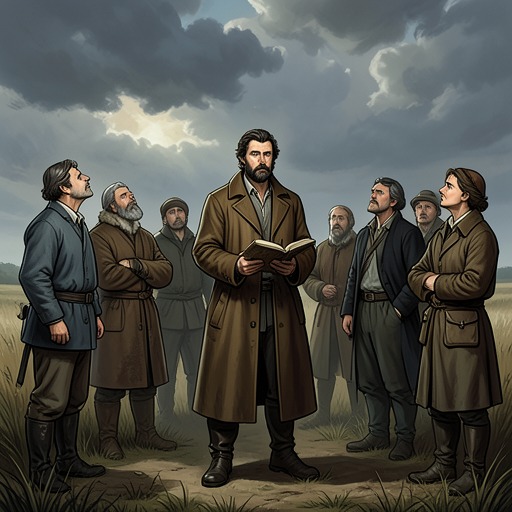
In May 1857, Buchanan accused the Mormons of a series of treasonous acts and dispatched federal officials to restore what he called the rule of law in Utah. He appointed a new territorial governor to replace Young and sent 2,500 heavily armed soldiers to escort the officials to Salt Lake City and subdue the Saints if necessary. The scale of the deployment made the intervention resemble a declaration of war, even though its stated administrative purpose included installing a small group of officials in a distant territory.
The episode became known as the Utah War, but its military character was limited. Historians have compared it to comic opera: the United States had sent the largest peacetime army in its history to oversee the installation of a handful of officials in a minor territory. A settlement was ultimately negotiated before the Saints and American soldiers exchanged a single shot. The mismatch between the size of the force and the bloodless resolution became part of the event’s enduring character.
Competing Legal Orders
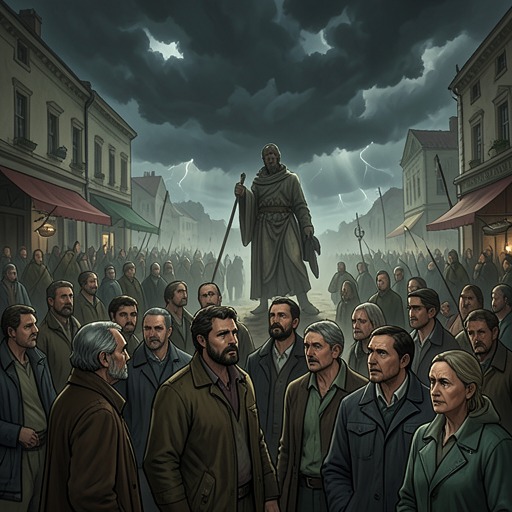
The confrontation reflected a deeper struggle over jurisdiction. Because Utah remained a territory rather than a state, federal courts were supposed to hold legal power. The Mormon-dominated Utah Territorial Legislature expanded local probate courts, which Young controlled, and thereby displaced federal jurisdiction in important areas. Many probate judges were Mormon bishops, while juries were largely composed of church members who were instructed by church leaders. Federal officials complained that Young had turned the territory into a theocratic dictatorship.
This local legal order gave institutional form to the claim that God’s law outranked the laws of the United States. It also helps explain why replacing a governor could not, by itself, settle the conflict: competing authorities were embedded in the territory’s courts and political arrangements, as well as in religious doctrine. Later critics of government regulation likewise framed demands such as licensing and taxation as illegitimate intrusions on rights they understood as fundamental, a position that echoed the older dispute over the reach of federal power.
Aftermath and Continuing Dispute
The Utah War neither removed Young from power nor ended plural marriage. Its failure to settle those questions frustrated successive American presidents, and legal and legislative challenges continued. That pressure culminated in the Edmunds-Tucker Act of 1887, which disincorporated the LDS Church and transferred to the federal government church property worth more than $50,000. Under sustained pressure, church leaders publicly renounced plural marriage in 1890. They also quietly sent groups of Mormons to establish polygamous colonies in Mexico and Canada, while some senior LDS authorities secretly continued plural marriages into the twentieth century.
The change in church policy eventually helped the LDS Church gain acceptance in American public life, but Mormon Fundamentalists regarded the abandonment of plural marriage as a betrayal of a central religious principle. Some later fundamentalists treated the 1890 decision as capitulation to a godless government and concluded that the modern church had departed from its true course. In that sense, the Utah War did not simply conclude in a bloodless compromise: it marked an early, unresolved confrontation in a long struggle over religious freedom, federal authority, and the legitimacy of plural marriage.